Marker Text
Built in 1866 by John Jones Dimmitt; of
native limestone hauled by ox-drawn
wagons. Home of prominent citizens in
Georgetown over 100 years. Dimmitt -- a
surveyor, lawyer, mathematician,
linguist, one time county attorney, and
partner in building of Georgetown
Railroad -- was civic leader;
instrumental in getting Southwestern
University moved to Georgetown.
Preserved since 1948 by Dr. and Mrs.
R.W. Gamble. Recorded Texas Historic
Landmark - 1967
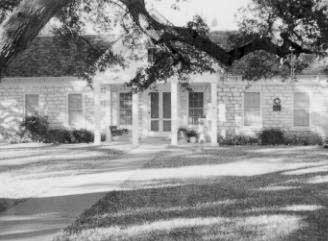
The John J.
Dimmitt House is a 1-1/2 story stone
dwelling facing south along West
University (Hwy 29) in Georgetown,
Texas. The center-passage dwelling is
built of cut-ashlar limestone and
covered fin a large side-gabled roof
with projecting gable over the principal
entry Double wooden doors provide entry
at the center of the house. Wooden 6/6
windows flank the doorway and form an
A-A-A-BB-A-A-A arrangement. Mature live
oaks surround the house with small
shrubbery adjacent to the stone
foundation. A 1-story garage is at the
northwest corner of the house and is
Noncontributing.
The John J.
Dimmitt House faces south along West
University (Hwy) 29 in Georgetown,
Texas. Although set back from the
highway approximately 500 feet, the
house is largely visible from the road
and sits on a rise of live oaks
immediately west of the San Gabriel
River. Approximately six acres of
undeveloped land surrounds the house.
Immediately west of the undeveloped
land, however, is a shopping center
built in the early l990s.
The Dimmitt
House is a 1-1/2 story center-passage
dwelling built of cut ashier limestone.
Resting on a stone foundation, the house
is covered by a large side-gabled roof
of wood shingles. Box eaves with
jig-sawn brackets connect the expansive
roof to the stone. A large gable-front
portico with window extends from the
center of the house and rests on four
square wooden posts set on a concrete
porch. This alteration dates to 1948.
Gable end interior chimneys rise above
the roof-line and end in corbeled caps.
A metal cresting runs along the
ridgeline of the roof adding a Late
Victorian element.
The principal
(south) facade forms an A-A-A-BB-A-A-A
arrangement. All windows are 6/6 wooden
double-hung with screens. Double wooden
doors with screens are centered on the
facade.
A
Noncontributing 1-story garage is
northwest of the dwelling.
The John J.
Dimmitt House (ca. 1870) is an good
example of late 19th century vernacular
architecture and the home of one of the
community's leading citizens. The
center-passage house is constructed of
local ashlar-cut limestone but built in
a traditional form. It is one of
Georgetown's earliest buildings in this
form and associated with the multiple
listing: Historic Resources of
Georgetown, Texas (NR 1986). :Dimmitt
was active in the early social and
economic development of Georgetown.
Thus, the house is nominated under
Criterion B for its association with
John Dimmitt in the areas of Commerce
and Social/Humanitarian at the local
level of significance.
John J. Dimmitt
came to Georgetown in 1859, but returned
to his native Missouri in 1861. In 1864
Dimmitt again moved to Georgetown and
purchased a lot near downtown. Dimmitt
gradually began to buy land around
Georgetown for raising livestock. In
1866, he is shown on the Williamson
County tax rolls with 4,814 acres, 536
horses, and 2,911 head of cattle.
Although his land holdings at times were
quite large, he did not own any land in
the C. Stubble field Survey until 1870.
Dimmitt is listed with the Texas State
Comptroller as the owner of a 10-acre
tract of land in this survey in 1870
with a given value of $400. Thus, the
Dimmitt House is dated as ca. 1870.
John J. Dimmitt
became a leading citizen in Georgetown
and Williamson County during the 1870s
and 1880s. Local historians believe that
he was a surveyor, lawyer,
mathematician, linguist, and also held
elected office in the county. He is
believed to have been among the
organizers of Georgetown College, a
predecessor of Southwestern University,
and to have been involved in attracting
Southwestern to Georgetown. Dimmitt also
became one of the Georgetown citizens
invested in the Georgetown Railroad
Company. Chartered in 1878, the company
built a rail line to Round Rock (10
miles) for service to the International
and
Great Northern Q&GN) Railroad. The
line was not profitable and was sold
under foreclosure in 1879 to the I&ON.
Although this investment was not
financially successful, it is another
example of Dimmitt's efforts to build
Georgetown. He was also interested in
the social and educational advancements
in Georgetown and donated 200 acres of
land behind his house to the Texas
Chautauqua Assembly active in the late
19th century. The Chautauqua became a
significant social organization for
Georgetown and surrounding areas.
On May 9, 1884,
John J. Dimmitt died. His wife, M.L.
retained title to the property and house
until 1917 when she sold it to Miff J.
Ischy. In 1947, Dr. R.W. and Jean Gamble
acquired the house and surrounding land.
The Gambles updated the property and
added the gable-front portico in 1948.
In spite of these changes, the Dimmitt
House retains a significant part of its
integrity.
T. J. Caswell
was the foreman of the Williamson County
jury that returned the first guilty
verdict in US history against a Ku Klux
Klansman, Murry Jackson of Taylor, in
1923, for flogging and tarring a white
man, sentencing him to five years in the
state penitentiary, the maximum sentence
allowed by law.